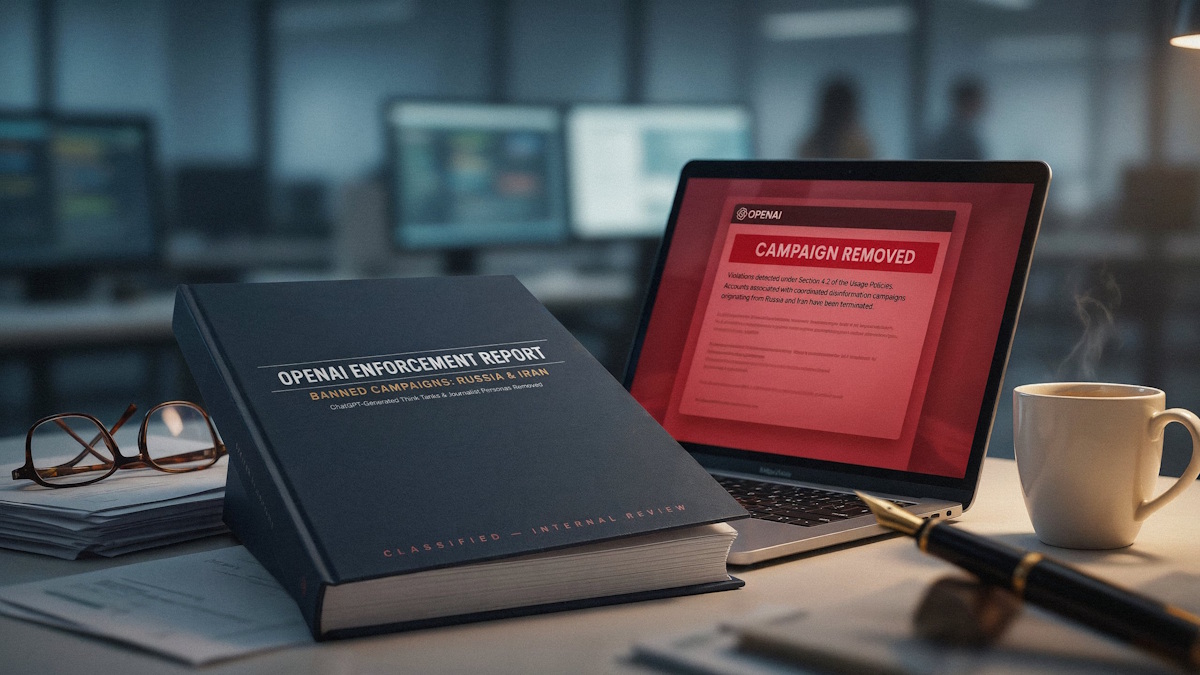
OpenAI said on Thursday that it banned two covert influence operations—one originating in Russia and the other in Iran—that used ChatGPT to support deceptive “false front” organizations and place political messaging in real media outlets. The company said the campaigns used AI alongside conventional propaganda tactics to “launder geopolitical, conflict-related messaging” into target audiences.
The Russia-linked operation, which OpenAI calls “Dark Clark,” was assessed at Category 5 on the company’s six-point IO Breakout Scale—the highest-impact operation OpenAI says it has disrupted since it began publishing these reports. The Iran-linked campaign, “Bogus Bylines,” was assessed at Category 4.
Russia: ‘Dark Clark’
OpenAI said it banned a cluster of ChatGPT accounts originating in Russia that targeted countries across Latin America. The operators prompted mostly in Russian, used VPNs to access ChatGPT, and focused on damaging Ukraine’s reputation in the region while also seeking to influence politics in Argentina and Bolivia.
The operation’s central front was the Social Research Center (SRC), a self-described research platform in Latin America. OpenAI said Russian operators controlled it through a fabricated persona, “Mia Clark,” while local staff appear to have been unaware that they were working for a Russian influence operation.
The operators used ChatGPT mainly to draft internal reports to an unknown superior, including updates on efforts to discredit Ukraine, undermine Ukrainian military recruitment, interfere in Bolivian and Argentine politics, and manage the SRC. OpenAI found more than 60 articles on the SRC website, most of which appeared to be original work produced by the unwitting local staff.
The campaign also created fake “leaked” documents and audio scripts. OpenAI said one fake email, purporting to come from Lima’s education authorities, instructed Peruvian schools to hold Ukraine-themed events referencing Stepan Bandera—a figure associated in Russia and Poland with fascism and wartime atrocities. The resulting coverage appeared in Peruvian and Polish media and drew a response from a Polish member of the European Parliament.
Another alleged operation used a fake email to push schools in Ecuador to hold a ceremony pledging allegiance to President Daniel Noboa and former Blackwater chief Erik Prince. OpenAI said it identified media coverage resembling the claim and a rebuttal from Ecuador’s education minister.
OpenAI cautioned that the operators frequently claimed credit for events they did not carry out, so their internal reports cannot be taken at face value. Still, the company said open-source evidence corroborated several fakes that were later fact-checked or officially denied.
Iran: ‘Bogus Bylines’
OpenAI said it banned a separate cluster of ChatGPT accounts originating in Iran. The operators prompted in Persian, produced content in Persian and English, and used VPNs to conceal their location.
The campaign used seven invented journalist personas—Ervin B. Hoskins, Noah Lamington, Sophia Gonzalez, Michael Harrison, Ericka Feusier, Jenny Williams, and Alice Johnson—to pitch long-form English-language articles to small and mid-sized online outlets. The articles focused on the U.S.-Iran conflict and portrayed the United States as the aggressor, Israel as an unreliable U.S. ally, and Iran as a resilient victim.
OpenAI identified nearly 100 articles published or syndicated under those bylines across more than a dozen outlets between July 2025 and October 2026. The company said publication activity increased sharply after the outbreak of the U.S.-Iran conflict.
The operators also asked ChatGPT to generate batches of social-media comments in English and Persian, often posted within minutes of one another. OpenAI said those comments generally received little engagement and did not dominate the discussions they entered.
Unlike the Russian operation, OpenAI could not identify who ran the Iranian campaign. It said the activity was consistent with a commercial actor conducting a for-hire influence operation, but it could not establish a connection to the Iranian government.
Why it matters
OpenAI said both campaigns show how AI can make covert influence work faster, more fluent, and easier to scale—while allowing operators to exploit unsuspecting employees, editors, and audiences. But the company also argued that exposure can disrupt such operations: earlier fronts including “Alice Donovan” and “PeaceData” ceased activity after being publicly identified.
OpenAI said it shared information on both cases with relevant authorities and industry partners.
Reference: openai